Quick facts
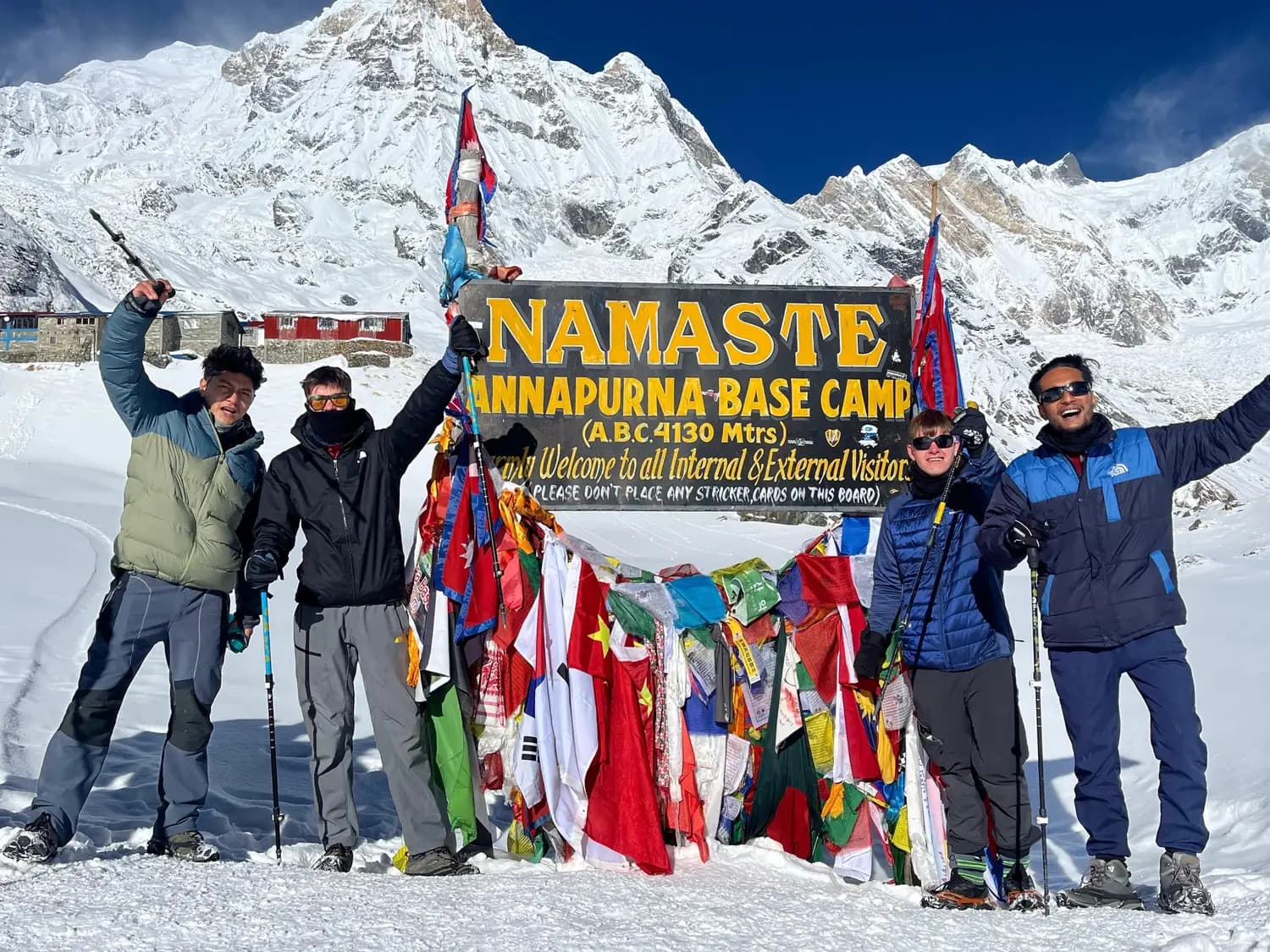
Walk through rhododendron forests, Gurung villages, and natural hot springs to reach the dramatic glacial amphitheater of Annapurna Base Camp at 4,130m, ringed by six peaks above 7,000m.
Overview
The Annapurna Base Camp trek is the route I have guided more times than any other, and it still holds my attention. You move through a remarkable compression of landscapes in just a few days — terraced fields above Nayapul, dense rhododendron and bamboo forest above Chhomrong, the open moraine shelf at Deurali, and then that final push across the Annapurna Sanctuary glacier to base camp itself. Standing inside that ring of giants — Annapurna I at 8,091m, Hiunchuli, Machhapuchhre, Gangapurna, Annapurna South — with the glacier crunching underfoot is something I never get tired of witnessing.
The route from Pokhara typically follows the classic path through Nayapul or Jhinu Danda, climbing through the Gurung village of Ghorepani for Poon Hill sunrise before dropping into the Modi Khola valley and ascending through Chhomrong. Above Chhomrong the teahouses thin out and the terrain becomes more serious — a long stone staircase descent, then an increasingly enclosed gorge with waterfalls on both walls before the valley opens into the Sanctuary. I watch altitude gain carefully above Deurali at 3,200m because the route to base camp adds nearly 900 metres in a single day, which is fast. I won't rush that section regardless of group enthusiasm.
On the descent I always try to time an afternoon at the Jhinu Danda hot springs by the Modi Khola — genuinely hot water, genuinely cold air, and genuine relief after days above 3,000m. It is one of the best rewards on any trail I know in Nepal. The full circuit takes 7 days at a steady pace; I recommend 9 days for most groups so there is room to respond to weather or acclimatisation without cutting corners. March to May brings rhododendron in bloom; October and November give the clearest mountain views.
Who this trek is for
Anyone who can manage 5-7 hours of walking per day on mountain terrain and is comfortable sleeping at 4,130m. No technical climbing required. Previous trekking experience is helpful but not essential — the route is well-marked and teahouse infrastructure is solid throughout. Good physical conditioning before the trip makes a real difference on the Ghorepani staircase and the final climb to base camp.
Best views & moments
- Standing inside the Annapurna Sanctuary enclosed by six peaks above 7,000m, with glacier underfoot
- Sunrise from Poon Hill at 3,210m illuminating Dhaulagiri and the full Annapurna range
- Natural hot springs at Jhinu Danda beside the Modi Khola river on the descent
- Gurung village life in Chhomrong — stone houses, terraced fields, and close Annapurna South views
- Machhapuchhre growing closer and taller with every hour of upward walking through the gorge
- Dense rhododendron forest on the Ghorepani to Tadapani ridge, blazing red and pink in March and April
- The moment the glacier amphitheater opens fully at Machhapuchhre Base Camp before the final push
- Remote bamboo and fern forest in the gorge section between Dovan and Himalaya Hotel, often misty and quiet
Day-by-day itinerary
Route & terrain
The classic ABC route begins with a jeep drive from Pokhara to Nayapul in the Modi Khola valley, where the trail starts flat before climbing steadily to Tikhedhunga. The first major challenge is the stone staircase ascent to Ghorepani at 2,874m, a genuine lung test that rewards with immediate Dhaulagiri views on arrival. Most itineraries include a pre-dawn side hike to Poon Hill (3,210m) before continuing east along a forested ridge to Tadapani, then dropping to the Modi Khola and climbing again to Chhomrong.
Chhomrong is the last real village with full amenities before the Sanctuary, and it sits on a dramatic shelf directly below Annapurna South. From here the trail descends the iconic stone staircase into the Chhomrong Khola gorge and begins the long enclosed climb toward the Sanctuary. The gorge gets narrower and the vegetation gets denser through Sinuwa, Bamboo, and Dovan before opening at Himalaya Hotel. Deurali marks the upper edge of the forest; above it the terrain becomes alpine, the air noticeably thinner, and Machhapuchhre dominates the view ahead.
Machhapuchhre Base Camp at 3,700m is a natural overnight stop that eases the altitude gain before the final walk across glacial moraine to Annapurna Base Camp at 4,130m. The descent retraces the ascent route and is typically faster, with the option to exit via Jhinu Danda for the hot springs rather than back through Ghorepani. The total return to Nayapul from ABC takes two solid days.
General info
Difficulty & preparation
The Annapurna Base Camp trek is rated Moderate and that is an honest rating for a fit person, though it has two genuinely hard days. The climb from Tikhedhunga to Ghorepani involves over 1,300 metres of elevation gain, much of it on stone staircases — it will test anyone's legs and lungs on day two when they are not yet in trail shape. The Chhomrong staircase, which you descend on day five, is over 2,000 steps and brutal on knees going down.
Daily walking time ranges from 3 hours on the short connector day to 7 hours on the Ghorepani approach and the Dovan-to-MBC segment. Most days are 5-6 hours at a reasonable pace. Altitude is the main risk factor. The route gains 430 metres from Machhapuchhre Base Camp to Annapurna Base Camp in a single morning — not extreme, but if anyone has been showing early AMS symptoms the night before, I will not push forward. Terrain above Deurali is open moraine with potential for snow and ice in early spring and winter. Proper trekking boots with ankle support are essential; trail runners are insufficient above Deurali. No ropes, technical equipment, or climbing experience needed.
How to prepare
Start cardiovascular training at least 8 weeks before your trek date. The most effective preparation is sustained aerobic exercise: running 30-45 minutes three times a week, hiking with a loaded pack on weekends, and stair climbing. The Ghorepani ascent is relentless, and people who arrive without leg conditioning find it genuinely demoralizing. Leg strength matters as much as lung capacity — add squats and lunges to your routine.
For acclimatisation, the itinerary itself provides sufficient gradual altitude gain if you do not rush. The key is not skipping the Machhapuchhre Base Camp overnight; people who push directly from Deurali to ABC in a single push without sleeping at MBC have a higher AMS rate in my experience. Drink 3-4 litres of water per day on the trail regardless of thirst. Avoid alcohol at altitude.
Arrive in Pokhara a day before the trek starts. If you are flying directly from a low-altitude country, that extra rest day matters. Carry Diamox (acetazolamide) as a precaution — consult your doctor before departure for dosage. Know the symptoms of AMS: persistent headache, nausea, loss of appetite, unusual fatigue. If you report any of these above 3,500m, we descend. That is not negotiable.
Permits you'll need
Annapurna Conservation Area Permit (ACAP)
USD 30 per person
Required for all foreign nationals. Obtainable in Kathmandu at the Nepal Tourism Board or in Pokhara. I sort this before we leave.
TIMS Card (Trekkers' Information Management System)
USD 15 per person (approx. NPR 2,000)
Required for trekking in the Annapurna region. Individual trekkers pay NPR 2,000; group trekkers pay NPR 1,000. Obtained at the Nepal Tourism Board office.
I handle all permit paperwork as your licensed guide.
Altitude & acclimatisation
Acute Mountain Sickness is the main medical concern on this route. The route reaches 4,130m at base camp, which is not extreme by Himalayan standards but is high enough to cause serious AMS in unprepared or unlucky trekkers. The fastest altitude gain is from Machhapuchhre Base Camp (3,700m) to Annapurna Base Camp (4,130m) — a 430m single-morning gain that follows two days of continuous climbing above 2,000m.
Sleeping altitudes on a typical itinerary: Tikhedhunga 1,540m, Ghorepani 2,874m, Tadapani 2,630m, Chhomrong 2,170m, Dovan 2,600m, MBC 3,700m, ABC 4,130m. The acclimatisation profile is reasonably gradual. The drop to Chhomrong on day four actually helps — getting below 2,200m before climbing again gives the body time to adjust before the big push above 3,000m.
I watch for headache, nausea, and unusual fatigue in any group member above Dovan. At MBC, anyone who woke with a headache gets a rest morning before we assess. I carry a pulse oximeter on every trek — a reading below 75-78% at MBC or ABC warrants serious attention. Descent is the only reliable cure for AMS; I will not let pride or schedule override that decision.
Food & accommodation
The ABC route is one of the best-serviced trekking routes in Nepal, with teahouses at every major stop. Accommodation is in twin rooms with basic furnishings — wooden beds, blankets, and not much else above Chhomrong. Hot showers exist but usually require a small extra payment. WiFi is available in most teahouses as far as Deurali but becomes unreliable above that.
Meals on this route are consistent and reliable. Dal bhat — rice, lentil soup, vegetable curry, and pickles — is the staple and the best value, often with free refills. Pasta, noodle soup, fried rice, porridge, and pancakes are available everywhere. Teahouse kitchens are generally clean and food is hot. I recommend sticking to cooked meals and boiled or bottled water — the river water in the gorge looks clean but should not be consumed untreated. Prices are reasonable at Ghorepani and Chhomrong; they rise noticeably at Himalaya Hotel and above. Budget around USD 30-50 per day for food and accommodation on the trail.
What to pack
The ABC route has teahouses throughout with charging facilities and basic supplies, so you do not need to carry food or camping equipment. Your pack should stay under 8-10kg. Key items specific to this route: warm layers rated to -10°C or below for base camp nights (even in October temperatures can drop hard), waterproof jacket and trousers (the gorge section below Himalaya Hotel catches moisture even in clear weather), and good trekking poles for the Chhomrong descent.
Trekking boots with ankle support are non-negotiable above Chhomrong. Trail runners work on the lower trail but not on the rocky, potentially icy terrain above Deurali. A lightweight down jacket is useful from Dovan upward. Sun protection is important at altitude — sunscreen, sunglasses with UV protection, and a hat. I also recommend trekking gaiters for early spring when snow is still present on the upper trail. Teahouses sell snacks and bottled water along the route but prices increase with altitude, so carry some emergency food. A headlamp is essential for the Poon Hill pre-dawn start.