Quick facts
A quieter Annapurna alternative that rewards you with close-up views of Machhapuchhre and Annapurna South from a ridge-top trail few trekkers know exists.
Overview
Mardi Himal is the route I recommend when someone wants an honest Annapurna experience without walking in a procession of trekkers. The trail peels off the main Annapurna circuit near Dhampus and climbs its own ridge — through rhododendron forest, past the small clearings at Low Camp and Forest Camp, and eventually up to High Camp at 3,550m before the final push to the Upper Viewpoint at around 4,200m or, for those who want more, the base camp plateau at 4,500m.
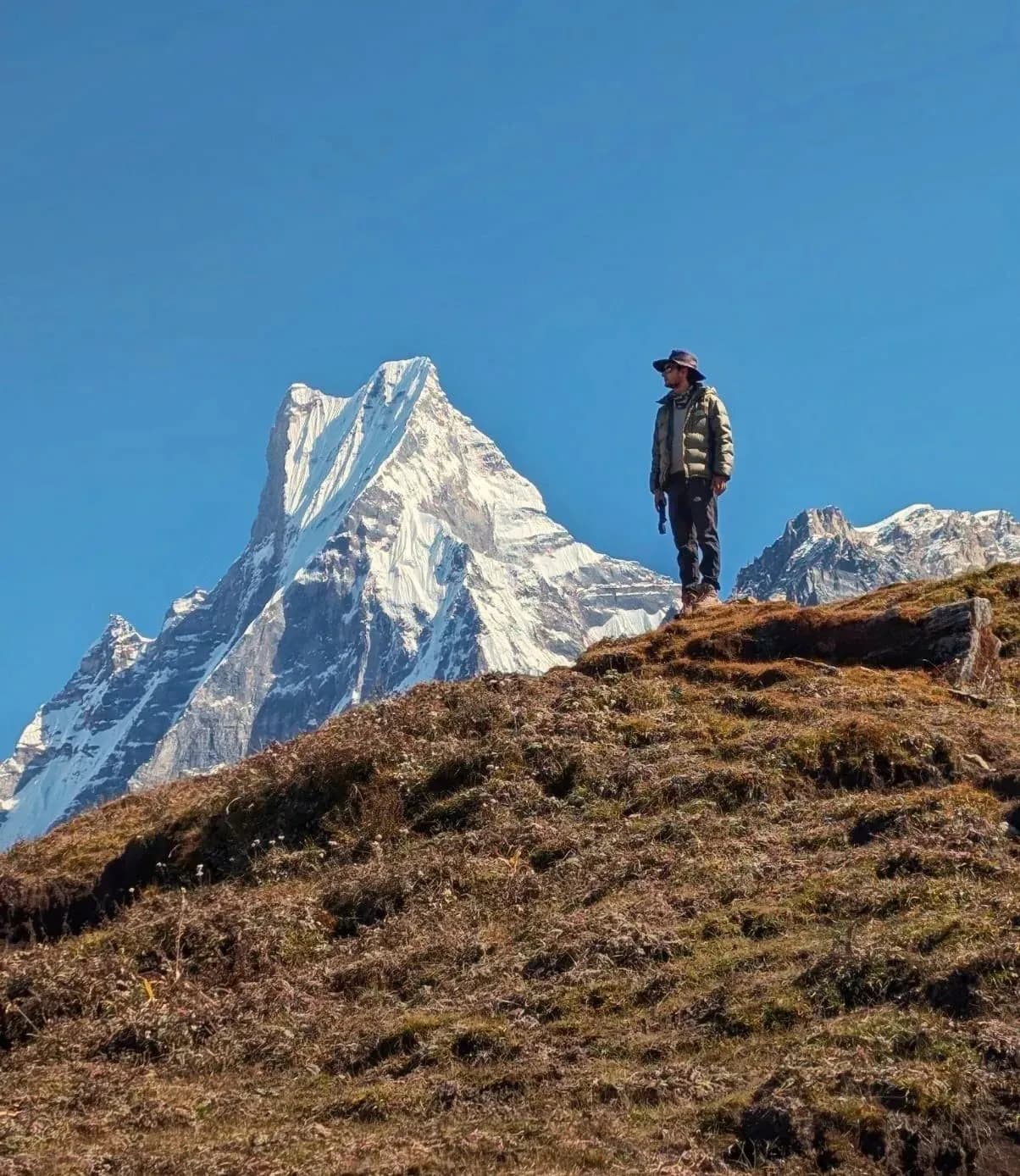
What strikes most people is how different the perspective is from here compared to Poon Hill or the ABC trail. Machhapuchhre fills the sky almost directly in front of you at High Camp in a way that even photographs don't quite capture. Mardi Himal itself — a sharp, rarely-climbed peak — stands to the north-east, and the Annapurna massif stretches across the full western horizon. I have guided this trail dozens of times and I still look up every single morning at High Camp.
The trail is well-suited to first-time trekkers in Nepal. The only permit required is the Annapurna Conservation Area Permit (ACAP), checked at Pothana above Dhampus. Maximum sleeping altitude is High Camp at 3,550m — manageable for most healthy walkers ascending gradually over four or five days. The descent typically runs through Badal Danda and Low Camp to Siding village, where a jeep ride back to Pokhara saves retracing your steps and gives you a genuine Gurung village as your last cultural stop.
Who this trek is for
Mardi Himal works well for first-time Himalayan trekkers who are fit but not experienced at altitude, and for returning visitors who have already done Poon Hill or ABC and want something less crowded. The short duration and modest sleeping altitude (3,550m) make it the most forgiving of the Annapurna region's significant viewpoint treks. Families with active teenagers handle it comfortably in five days.
Best views & moments
- Machhapuchhre filling the horizon from High Camp — closer than almost any other trail in the region
- Ridge walking above the clouds between Low Camp and High Camp with the Annapurna giants flanking either side
- Optional extension to Mardi Himal Base Camp at 4,500m on a seldom-walked plateau
- Rhododendron forest in full bloom between Dhampus and Forest Camp during March and April
- Gurung hospitality in Siding village at the end of the descent — quieter and more genuine than the main trail towns
- Sunrise at High Camp painting Annapurna South and Hiunchuli gold while the valleys below stay dark
- Small teahouses run by local families who know me by name — nothing packaged, nothing corporate
Day-by-day itinerary
Route & terrain
The trail begins at Phedi or Kande, a 45-minute drive from Pokhara, where a short but steep ascent reaches Dhampus village perched on a ridge at 1,650m with its famous first view of Machhapuchhre. From Dhampus the path climbs through agricultural terraces and into oak and rhododendron forest, passing the ACAP checkpoint at Pothana before entering the forest zone toward Pitham Deurali. At Deurali the Mardi Himal ridge route branches left away from the Annapurna Base Camp path — this is where the teahouse density drops and the trail becomes your own.
The ridge ascent from Forest Camp to High Camp is the heart of the trek. The trail follows the crest of the Mardi Himal spur, alternating between forest corridors and exposed ridge sections where sudden views of Machhapuchhre appear through gaps in the trees. Low Camp at 2,985m marks the tree line transition; above it the vegetation shifts to scrubby juniper and alpine grass. High Camp at 3,550m is a cluster of six or seven teahouses on an open ridge — exposed but magnificent, with Machhapuchhre directly ahead and the Annapurna South and Hiunchuli massif to the west.
The final ascent to the Upper Viewpoint follows the ridge north-east on a trail that becomes stonier and steeper above 4,000m. The Upper Viewpoint at roughly 4,200m is the standard turnaround — a boulder field perch with 180-degree mountain views. The optional extension to Mardi Himal Base Camp at 4,500m crosses broken moraine for a further 45 minutes. Descent from High Camp runs south along the Mardi ridge, cutting through Badal Danda before dropping steeply to the low-land Gurung settlement of Siding, where the route ends with a jeep ride rather than a repeat of the ascent trail.
General info
Difficulty & preparation
Mardi Himal is rated easy-to-moderate and is genuinely accessible to first-time trekkers. There are no technical sections, no glacier crossings, and no scrambling above High Camp on the standard Upper Viewpoint route. The challenge is cumulative fitness over four to five consecutive days of uphill walking, mostly on stone steps and ridge paths.
Daily walking time ranges from four to seven hours depending on the day. The steepest sustained climbing happens between Forest Camp and High Camp on day three — about 930 vertical metres over 5-6 hours. Above High Camp the rocky path to the Upper Viewpoint gains another 650m at a gentler gradient, but the reduced oxygen at 4,000m makes the final hour feel noticeably harder than the numbers suggest.
The main physical concern is not technical difficulty but the mossy, lichen-covered stones in the forest zone between Dhampus and Low Camp, which become slippery after rain or in cold morning conditions. Trekking poles are strongly recommended, particularly on the descent. In winter (December-February), snowfall can cover the trail from Forest Camp upward, adding a layer of route-finding complexity and requiring gaiters and microspikes in some years.
Altitude is a secondary consideration at the sleeping elevations here — High Camp at 3,550m is well below the threshold where most healthy adults experience serious AMS. The optional base camp at 4,500m pushes into territory where mild symptoms (headache, fatigue) are more common, and I watch for these closely before allowing anyone to continue past High Camp.
How to prepare
A month of consistent cardiovascular training before arriving in Nepal makes Mardi Himal comfortable rather than a grind. Running, cycling, swimming, or hiking on local hills four to five times per week builds the aerobic base you need for five to seven hours of walking at elevation. Focus on uphill work if you have access to any gradient — stair climbing is underrated preparation for Nepal.
Strength training for the lower body helps on the descent days, which involve long sections of stone steps that punish the quads and knees. Some basic practice with trekking poles in the weeks before the trip is worth doing if you have not used them before — the technique makes a real difference on slippery forest sections.
On the health side, ensure any vaccinations recommended for Nepal are current (hepatitis A and B, typhoid, tetanus are the standard list — check with a travel health clinic). Bring a small pharmacy: ibuprofen for muscle soreness, acetazolamide (Diamox) as a precaution against mild AMS if your doctor approves it, blister supplies, and a basic antiseptic kit. The trail is close enough to Pokhara that serious emergencies can be handled with helicopter evacuation, but I prefer not to need it.
Arrange travel insurance before you arrive. Coverage should extend to at least 4,500m for the base camp option, and must explicitly include emergency helicopter evacuation. Nepal-based rescue can be organised quickly, but without insurance the helicopter costs are significant.
Permits you'll need
Annapurna Conservation Area Permit (ACAP)
NPR 3,000 (~USD 22) for foreigners; NPR 1,000 for SAARC nationals
The only permit required for Mardi Himal. Checked at Pothana above Dhampus. Obtainable at the ACAP counter in Damside, Pokhara, or at the Nepal Tourism Board in Kathmandu. Bring passport copy and two passport photos.
I handle all permit paperwork as your licensed guide.
Altitude & acclimatisation
The sleeping altitude on Mardi Himal peaks at High Camp (3,550m), which is moderate by Nepal standards. The rate of ascent over the standard five-day itinerary is gentle enough that most healthy adults acclimatise without pharmaceutical assistance. From Forest Camp (2,620m) to High Camp (3,550m) the gain is around 930m in one day — just within the widely-cited guideline of 300-500m per night above 3,000m, and workable because Forest Camp is only marginally above the acclimatisation threshold.
The base camp option adds a 950m day-excursion above sleeping altitude (High Camp to 4,500m and back), which is generally well-tolerated as long as you descend to sleep rather than stay at altitude. I watch closely for headache, loss of appetite, or unusual fatigue at High Camp — these are the early signals that the body needs more time, and I will extend the rest day there if warranted.
Acute Mountain Sickness (AMS) symptoms on this trek are typically mild and resolve with descent or a slower pace. True severe AMS (HACE or HAPE) is rare at these altitudes but not impossible. The golden rule applies: if symptoms worsen instead of improving, we descend without debate. Helicopter evacuation to Pokhara from High Camp takes around 15 minutes — fast enough that the backup is reliable, but insurance is non-negotiable.
Food & accommodation
Teahouses on the Mardi trail are family-run and relatively simple — wooden rooms, two to four single beds, shared squat toilets, and solar-powered electricity that becomes unreliable at High Camp in overcast weather. The rooms are functional and warm enough with the supplied blankets, though I always recommend a sleeping bag liner at minimum and a light down bag at High Camp.
Meals follow the standard Nepali teahouse menu: dal bhat (unlimited refills, genuinely the best fuel for a long day on the trail), noodle soups, fried rice, eggs, porridge, and Tibetan bread for breakfast. The menu becomes simpler at Higher Camp where supply logistics are harder, so I encourage people to eat their larger meal at lunch when the body is working hardest. Garlic soup in the evenings is both warming and mildly helpful for circulation at altitude.
Prices increase with altitude — a bottle of water that costs NPR 80 in Pokhara runs NPR 150 at Forest Camp and NPR 300 at High Camp. Budget roughly NPR 2,000-3,000 per day for food and incidentals once you are on the trail. ATMs and currency exchange are only available in Pokhara — withdraw sufficient rupees before starting.
What to pack
Mardi Himal's compact duration means you can travel light by Himalayan standards. A 40-50 litre pack works well if you are sharing a porter — I assign one porter per two trekkers, each carrying up to 12.5kg of your gear. You carry only your daypack.
Key items specific to this route: trekking poles (non-negotiable on the descent — the stone steps are unforgiving on knees), a sleeping bag rated to at least -5°C (High Camp teahouses have blankets but the rooms are cold at night), a warm mid-layer and an outer wind and waterproof shell. Temperatures at High Camp commonly drop to -5 to -10°C at night even in the spring and autumn trekking windows.
For footwear, mid-height lace-up trekking boots with ankle support are far superior to trail runners on this route — the stone steps and wet forest sections demand grip and lateral stability. Break them in thoroughly before the trip. Bring one spare pair of socks beyond what you think you need; wet feet in the forest zone are a morale killer.
Sun protection matters more at altitude than most first-timers expect. SPF 50+ sunscreen, UV-blocking sunglasses (wraparound preferred at the viewpoint), and a brimmed hat are essential. The UV index above 3,500m is significantly higher than at sea level. A small headlamp is needed for the 6am departure from High Camp to reach the viewpoint before clouds build.