Quick facts
Ride into Nepal's forbidden kingdom on a Royal Enfield — off-road tracks across the Trans-Himalayan rain shadow plateau to Lo Manthang's medieval walled city, sky caves, and the Tibetan border.
Overview
Upper Mustang is not like anywhere else in Nepal, and a motorbike is not like any other way to see it. The route from Jomsom to Lo Manthang follows the Kali Gandaki gorge north through the Tibetan plateau rain shadow — a landscape of wind-sculpted red cliffs, ancient cave villages, and fortress towns that feels more like the interior of Tibet than the Nepal most visitors know. On a bike you experience the scale of it in a way that a jeep window cannot replicate.
I guide this route on Royal Enfield 350/500cc bikes — the classic Himalayan choice, durable and appropriate for the terrain. The tracks above Jomsom are a mix of graded dirt road, river-bed crossings, and rocky switchbacks that require real off-road riding experience. This is not a leisure ride on tarmac. Riders should be comfortable with loose gravel, weight management on sustained inclines, and slow-speed technical sections. A 4x4 support jeep follows the group carrying spares, tools, and a backup mechanic — essential logistics for the terrain.
The destination is Lo Manthang, the walled capital of the Lo Kingdom at 3,810m, and the day ride toward the Tibet border at Kora La (4,600m). The monastery culture here is Tibetan Buddhist in the most complete sense — the Lhoba people of Lo have preserved their traditions largely because of the region's isolation, which the restricted area permit system has helped maintain. Visiting with that context matters to me; I try to guide this route in a way that respects the place rather than just consuming it.
Who this trek is for
Upper Mustang by motorbike is for experienced off-road riders who want more than a standard Nepal trek. You should be comfortable riding on loose gravel and dirt tracks, confident with slow-speed technical terrain, and willing to handle some mechanical unpredictability. A standard motorcycle licence is required. No prior Nepal riding experience is necessary, but some off-road riding background is strongly preferred — I do not recommend this to highway-only riders. Altitude experience above 3,500m is helpful but the riding commitment matters more for this tour.
Best views & moments
- Lo Manthang walled city — the ancient capital of the Lo Kingdom, home to Tibetan Buddhist monasteries unchanged for centuries
- Ride to Kora La at 4,600m near the Tibet border — one of the highest accessible points by road in Nepal
- Chosar sky caves carved into the red cliffs — 2,000-year-old mystery cave dwellings with murals and human remains
- Kali Gandaki Gorge — the world's deepest gorge, ridden through on the approach from Jomsom
- Kagbeni village at the gateway to the restricted area — medieval towers, prayer wheels, and the Kaligandaki river
- Tiji Festival if visiting in May — three-day sacred masked dance festival in Lo Manthang
- Muktinath temple (4,000m) en route — one of the most sacred Hindu-Buddhist pilgrimage sites in the Himalayas
Day-by-day itinerary
Route & terrain
The motorbike route to Upper Mustang begins at Pokhara (820m) and climbs north through the dramatic Kali Gandaki corridor — the world's deepest gorge, flanked by Dhaulagiri and Annapurna on either side. The ride from Pokhara to Jomsom (2,720m) follows the Annapurna Circuit road via Beni and Tatopani, climbing steadily through subtropical vegetation that gives way to the characteristic dry, wind-blown terrain of the Mustang district.
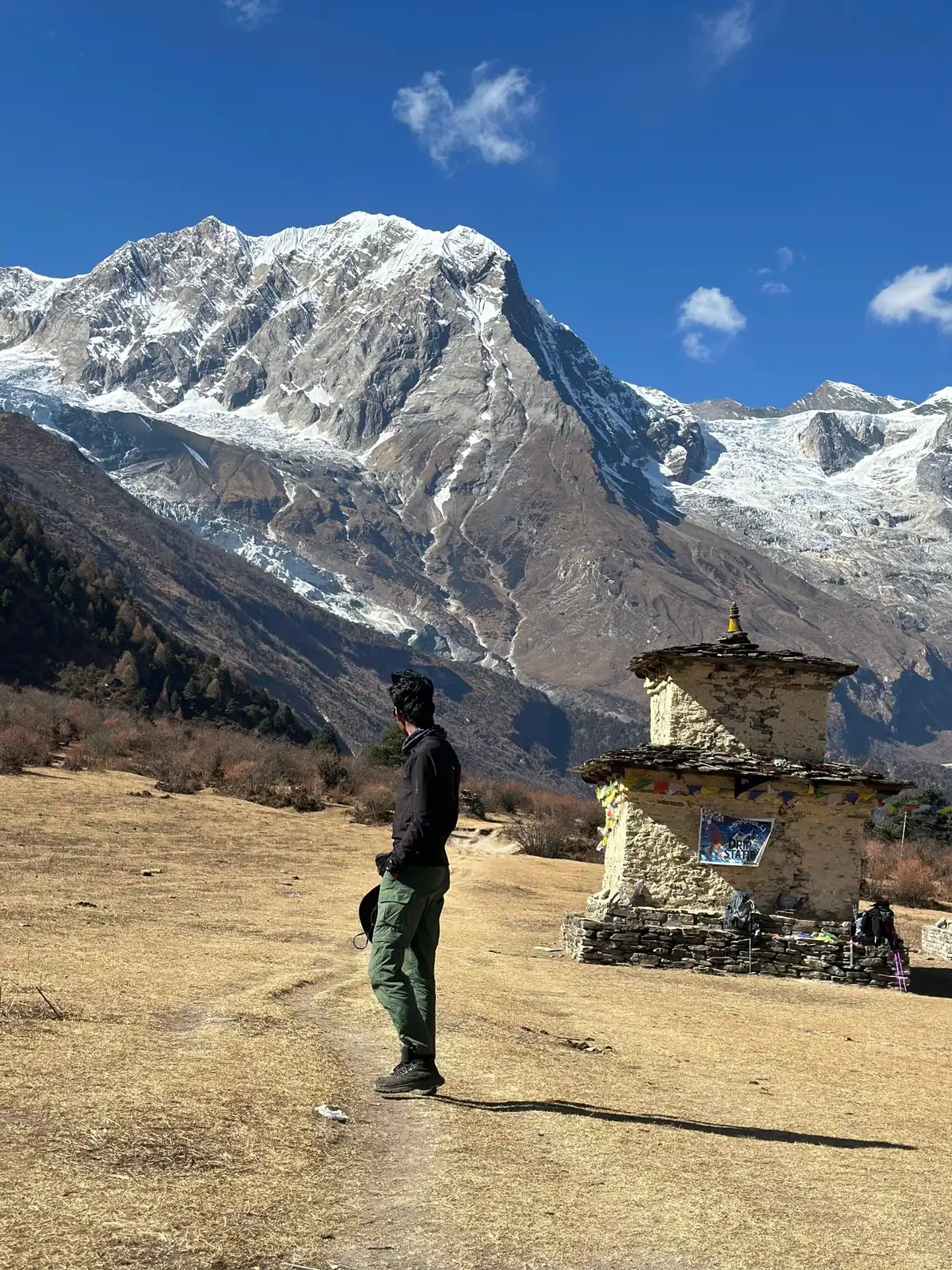
From Jomsom the terrain changes immediately. The Kali Gandaki becomes a wide, flat riverbed and the tracks north are proper off-road routes — gravel, river crossings, and loose switchbacks that require active riding. The restricted area begins officially at Kagbeni (2,800m) where permits are checked and stamped. Beyond Kagbeni the landscape is pure Trans-Himalayan plateau: red and ochre cliffs sculpted by wind into columns and caves, ancient chortens at village entrances, and a silence punctuated only by the wind and the bikes.
The main riding days cover Kagbeni to Ghami (via Chele and Syangboche), Ghami to Lo Manthang (crossing Tsarang La at 3,870m), and the day excursion from Lo Manthang toward Kora La at 4,600m. The tracks in the upper section become rougher and more technical — some sections require riders to pick lines through boulder fields or cross small rivers. The support jeep is essential here, both for mechanicals and for the occasional section where a heavy motorbike needs assistance through deep sand.
Lo Manthang itself is a medieval walled enclosure of roughly 200 households, the former capital of the Lo Kingdom. The monasteries — Jampa Lhakhang (15th century), Thupchen Gompa, Chyodi Gompa — are among the finest examples of Tibetan Buddhist architecture and murals in Nepal. The King's palace (now a museum) was built around 1400. The atmosphere of Lo Manthang on a quiet morning before the handful of tourists arrives is genuinely extraordinary.
General info
Difficulty & preparation
The Upper Mustang motorbike tour is rated moderate — relatively easy for experienced off-road riders, genuinely challenging for those without off-road background. The assessment depends almost entirely on riding experience rather than physical fitness. The tracks above Jomsom range from a compacted dirt road (manageable for confident novices) to loose-surface switchbacks, river-bed crossings, and boulder-strewn sections in the upper Mustang that demand active weight management and good throttle control.
Altitude is a secondary challenge specific to this tour. The maximum sleeping altitude is Lo Manthang at 3,810m, reached in two riding days from Jomsom (2,720m). The gain of 1,090m over two days is moderate, but the riding exertion at altitude adds physiological stress. The Kora La day excursion at 4,600m is the highest point of the tour and can bring on mild symptoms in people who are fine at Lo Manthang — the altitude gain is rapid and the cold at 4,600m is significant even in summer.
Weather is a specific risk factor on the motorbike route that does not affect trekking in the same way. Afternoon winds in the Kali Gandaki gorge are extremely strong (often 60-80km/h from the south by mid-afternoon) and are dangerous for motorbikes on the exposed sections. All riding days are structured to be completed before early afternoon, which shapes the daily rhythm of the tour. Rain makes the upper tracks significantly more difficult — the jeep support and the discipline to wait out bad conditions are both important.
How to prepare
Off-road riding experience is the most important preparation for this tour. If you ride primarily on tarmac, practise on gravel, dirt, and unpaved tracks for several months before coming to Nepal. Get comfortable with slow-speed balance, standing on the footpegs over rough terrain, and riding with a loaded bike that handles differently to your daily commuter.
Physical fitness matters less on a motorbike tour than on a trek, but sustained riding at altitude is more tiring than it sounds — the concentration required on rough tracks combined with altitude effects is fatiguing, and eight-hour riding days leave most people more depleted than they expect. General aerobic fitness, a strong core, and upper-body endurance (for managing the bike over rough terrain) all help.
Bring or arrange appropriate riding gear. A full-face helmet (I can source locally in Kathmandu or Pokhara), protective jacket with armour, riding gloves with palm protection, and over-the-ankle boots that protect the ankle joint. Lightweight hiking pants that fit over riding boots work for the upper body; full riding trousers with knee and hip armour are better. The sun at altitude is intense — full arm and leg coverage is advisable even in warm weather.
Permits you'll need
Restricted Area Permit (RAP) — Upper Mustang
USD 50 per person per day (as of 2025, replacing the old USD 500/10-day flat fee)
This permit is essential and can only be arranged through a registered trekking agency or travel company. It requires a minimum group of two people. I handle all RAP logistics from the Kathmandu Department of Immigration. For a 5-day restricted area component (Kagbeni to Lo Manthang and return), budget USD 250 per person.
Annapurna Conservation Area Permit (ACAP)
NPR 3,000 (~USD 22) for foreigners
Required as the route passes through ACAP territory. Obtainable in Pokhara or Kathmandu.
TIMS Card
NPR 1,000 (~USD 7) through a registered agency
Required for the Mustang district. I arrange all three permits together before departure.
I handle all permit paperwork as your licensed guide.
Altitude & acclimatisation
Upper Mustang is a high-altitude environment but the altitude gain is less gradual than a trek — two days of riding from Jomsom (2,720m) to Lo Manthang (3,810m) is a faster transition than most trekking itineraries allow. The exertion of off-road riding at altitude adds physiological load that is easy to underestimate.
The most significant altitude exposure is the Kora La day excursion (4,600m), which can be reached within 2-3 hours of riding from Lo Manthang. This rapid ascent from a 3,810m sleeping altitude to 4,600m is well above the threshold where AMS symptoms — headache, nausea, fatigue — are common. The key mitigation is acclimatising properly to Lo Manthang altitude before attempting the Kora La day, which means spending a full day in Lo Manthang first.
For riders who are not trekkers, altitude is a concept that may be unfamiliar. The air at 3,800m contains roughly 40% less oxygen than at sea level, which affects endurance, judgement, and reaction time — all of which matter when riding technical terrain. I build an acclimatisation day at Lo Manthang into the itinerary for this reason. If anyone in the group is showing significant altitude symptoms, the Kora La extension is dropped without negotiation.
Food & accommodation
Tea houses and basic guesthouses are the standard accommodation throughout the Upper Mustang motorbike route. Jomsom has the best options — proper hotels with hot showers, restaurant-quality food including the famous Thakali set menu (rice, dal, potato curry, fermented mustard greens, and various chutneys). The Thakali cuisine in Jomsom and Kagbeni is genuinely excellent and a highlight of the route in itself.
Above Kagbeni the guesthouses become simpler — stone-walled rooms with basic bedding, shared squat toilets, and food options that depend entirely on what the kitchen has managed to source or carry in. In Lo Manthang the guesthouses are modest but clean, and the evening meal culture — sitting with other riders or trekkers around a central stove with yak butter tea and momos — is memorable.
Motorbike-specific practicalities: fuel is available at Jomsom and at small petrol stores in some larger villages; above Kagbeni you cannot rely on fuel availability. The support jeep carries additional fuel cans. Engine oil and basic spare parts (tubes, levers, cables) should be in the jeep at all times. A mechanic travels with the group and handles roadside issues — this has resolved every mechanical situation I have encountered on this route.
What to pack
This tour has different packing requirements than any of the trekking itineraries. Your main luggage travels in the support jeep rather than on the bike, so heavy bags are not an issue — but you need a compact, waterproof tank bag or small backpack for the items you need access to during the day: water, snacks, sunscreen, phone, camera, and emergency warm layer.
Key Upper Mustang specifics: the Kali Gandaki wind is intense and cold even in summer — a neck gaiter or scarf under the helmet is worthwhile, and a wind layer over your riding jacket pays off on the long open sections. The dust in the upper valley above Kagbeni is significant — goggles (not just sunglasses) for the extended dusty sections protect both eyes and, with a buff, nose and lungs.
For the Kora La day (4,600m), an extra warm layer beyond your standard riding kit is necessary — temperatures at that altitude combined with wind make it genuinely cold even in May. The Lo Manthang nights drop well below freezing from October onward; a down jacket and -10°C sleeping bag (teahouses do have blankets but they are thin) are appropriate from September through November.