Quick facts
A restricted-area circuit around the world's eighth-highest mountain through remote Himalayan villages, crossing the Larkya La Pass at 5,106m with virtually none of the crowds found on nearby Annapurna routes.
Overview
The Manaslu Circuit is the trek I recommend when someone has done ABC or the Annapurna Circuit and wants something that feels genuinely different. The route encircles Mt. Manaslu (8,163m), the eighth-highest peak on earth, through a region that shares a cultural and linguistic world with Tibet rather than the Hindu lowlands. The restricted area permit requirement means the circuit never gets crowded, and the villages from Soti Khola to Samagaon have preserved a way of life that the more accessible Annapurna trails no longer show.
The trek begins in earnest from Soti Khola or Arughat, reached by road from Kathmandu, and follows the Budhi Gandaki river north through subtropical forest that gives way to increasingly arid, high-plateau terrain as you approach the Tibetan borderlands. Samagaun at 3,520m is the cultural and logistical heart of the route — a large Tibetan-influenced village with monasteries, yak herds, and a direct view of Manaslu's south face. I always build in a mandatory rest day here. Acclimatisation at Samagaun is not optional; the next sleeping altitude at Samdo (3,860m) and then the Larkya La (5,106m) cross require a properly adjusted body.
The pass crossing is the defining moment of the trek. You leave Dharmasala (4,460m) before dawn and climb steep, often icy terrain to the prayer-flag-festooned summit of Larkya La. The descent to Bimthang on the other side is long — over 1,600m of height loss in a single day — and legs are usually destroyed by the end. The circuit exits through the Annapurna Conservation Area past Dharapani, which means you also need an ACAP permit. Solo trekking is not permitted; a licensed guide and a minimum of two trekkers are required by government regulation.
Who this trek is for
Experienced trekkers who have completed a moderate multi-day trek before and want a more remote, culturally rich experience. The Larkya La Pass crossing at 5,106m requires genuine fitness, altitude tolerance, and the willingness to spend 10+ hours walking in a single day. Government regulations require a minimum of two trekkers and a licensed guide. Solo trekking is not permitted on this route.
Best views & moments
- Crossing Larkya La Pass at 5,106m, one of the highest trekking passes in Nepal, often with ice and snow
- Samagaun village at 3,520m — Tibetan-influenced stone houses, gompas, and Manaslu's south face directly ahead
- Walking the Budhi Gandaki gorge through subtropical forest, waterfalls, and hanging bridges
- Almost no crowds — the restricted area permit keeps daily trekker numbers low year-round
- Ancient Buddhist monasteries at Pungyen Gompa and Mu Gompa near Samagaun
- Views of Manaslu, Himalchuli, Ganesh Himal, and Annapurna II from the circuit
- The Tibetan-influenced architecture and dress of villages from Namrung to Samdo
- Remote camping atmosphere despite teahouse infrastructure — no day-trippers, no noise
Day-by-day itinerary
Route & terrain
The Manaslu Circuit follows the Budhi Gandaki river from the roadhead at Soti Khola or Arughat northward through a dramatic gorge that transitions from subtropical rice-terrace country to high-altitude Tibetan plateau over roughly five days of walking. The gorge section is genuinely remote — narrow enough that sunlight only reaches the valley floor for a few hours each day, with suspension bridges, waterfalls, and dense forest pressing in on both sides.
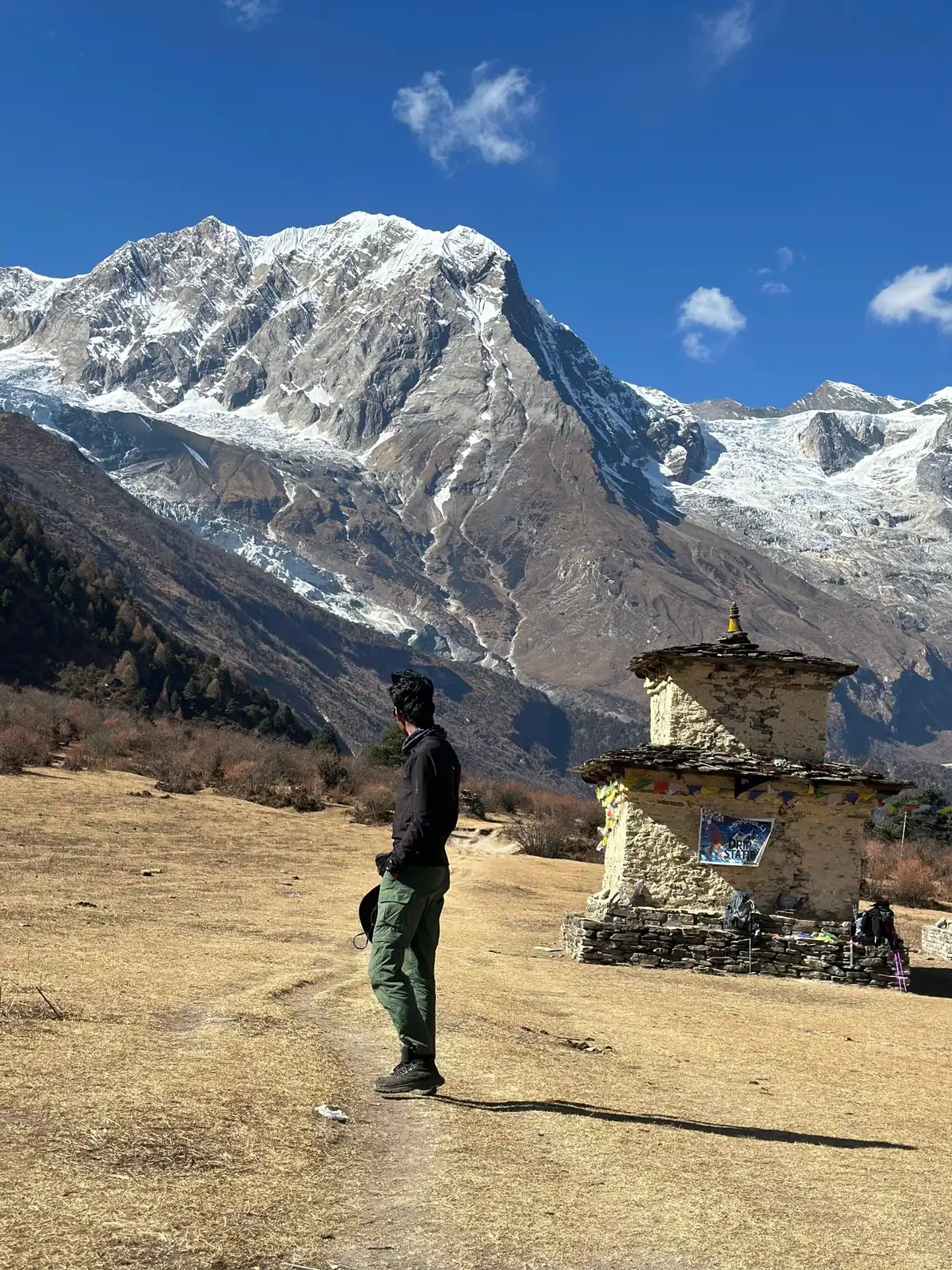
From Namrung upward the character of the route changes completely. Stone mani walls line the trail, chortens mark every ridge spur, and the villages of Lho, Shyala, and Samagaun have the flat-roofed, wind-braced architecture of the Tibetan highlands. Samagaun at 3,520m is the hub of the upper circuit — from here you can see Manaslu's south face clearly and the route to both the base camp and the Larkya La is visible.
The pass crossing from Dharmasala to Bimthang is the physical and psychological centrepiece of the trek. The climb from the 4,460m camp to the 5,106m pass takes 3-4 hours in thin air on rocky, often snow-covered terrain. The descent on the far side drops 1,600m to Bimthang and another 1,700m to Dharapani the following day. The circuit exits through the Marsyangdi valley into the Annapurna Conservation Area, ending at Besi Shahar for the road connection back to Kathmandu or Pokhara.
General info
Difficulty & preparation
The Manaslu Circuit is rated Challenging and earns that rating in two specific places: the sustained high-altitude walking across multiple days above 3,500m, and the Larkya La crossing itself. Daily walking time runs 5-7 hours on most days, with the pass crossing day requiring 9-10 hours from a 3-4am start.
The terrain varies considerably. The lower gorge (Soti Khola to Deng) involves rocky riverside trail with frequent bridge crossings and is not technically difficult but is unrelentingly steep in sections. The middle section (Deng to Namrung) adds altitude to the physical load. Above Namrung the trail is on open high-altitude terrain with loose rock and potential for snow.
The Larkya La approach from Dharmasala involves steep rocky and often icy slopes at and above 5,000m. Trekking poles and traction aids (microspikes or crampons in season) are strongly advised. Physical fitness needs to be higher than for ABC or the Poon Hill circuit — specifically, cardiovascular capacity at altitude matters more than pure leg strength, because the cumulative days of walking at 3,500-4,500m deplete reserves that low-altitude training cannot fully replicate. Previous multi-day high-altitude trekking experience is genuinely recommended.
How to prepare
Begin cardiovascular training 10-12 weeks before departure for the Manaslu Circuit. The circuit accumulates more total altitude gain than ABC and requires sustained output over 12-14 consecutive days. Running, cycling, and hiking with a loaded pack are all relevant — the goal is being able to walk 6-7 hours daily without the last two hours becoming a survival exercise.
High-altitude experience from a previous trek helps calibrate your acclimatisation response. If this is your first time above 4,000m, consider whether a shorter introduction at altitude before Manaslu would be wise — even a week at the ABC or Langtang level teaches you how your body handles thin air. For Manaslu specifically, the acclimatisation rest day at Samagaun (3,520m) and the short day to Samdo (3,860m) are built into the itinerary for good reason; I will not shorten them.
Carry acetazolamide (Diamox) prescribed by your doctor. Diamox does not prevent altitude sickness but it supports acclimatisation when used correctly. Know the AMS symptoms cold — on a restricted-area trek with no quick road access, early recognition and descent are more important than on accessible routes. Travel insurance that explicitly covers emergency helicopter evacuation from a restricted area is not optional.
Permits you'll need
Manaslu Restricted Area Permit (RAP)
USD 100 per week (Sep-Nov), USD 70 per week (Dec-Aug); USD 15/day beyond first week (Sep-Nov), USD 10/day (Dec-Aug)
The most significant permit — mandatory for the restricted zone from Jagat to Samagaun and the pass. Must be obtained through a registered trekking agency. Cannot be obtained by individuals.
Manaslu Conservation Area Permit (MCAP)
USD 27 per person
Required for all foreign nationals entering the Manaslu Conservation Area.
Annapurna Conservation Area Permit (ACAP)
USD 27 per person
Required because the circuit exits through Dharapani and Besi Shahar, which fall within the Annapurna Conservation Area.
TIMS Card (Trekkers' Information Management System)
NPR 2,000 per person (approx. USD 15)
Required when passing through the Annapurna Conservation Area section of the route.
Chumnubri Rural Municipality Permit
USD 100 per week (Sep-Nov), USD 75 per week (Dec-Aug)
Required for the core Manaslu Circuit area. Covers wards 1-4 of Chumnubri Rural Municipality. Obtainable through a licensed agency.
I handle all permit paperwork as your licensed guide.
Altitude & acclimatisation
The Manaslu Circuit spends more time above 3,500m than most other popular treks in Nepal, which is its key altitude risk factor. The sleeping altitude sequence is: Namrung 2,630m, Lho 3,180m, Samagaun 3,520m, Samdo 3,860m, Dharmasala 4,460m. The jump from Samdo to Dharmasala (600m gain in a short day) followed by the pass crossing to Bimthang (5,106m summit, 3,590m sleep) is the most extreme segment.
I carry a pulse oximeter on every Manaslu trek and check readings at Samagaun, Samdo, and Dharmasala. A resting SpO2 below 78% at Samagaun or below 72% at Dharmasala, combined with symptoms, warrants descending rather than continuing. The mandatory acclimatisation day at Samagaun and the short day to Samdo are the insurance against rushing this segment.
The high-altitude exposure on the pass crossing day is the greatest individual AMS risk: spending several hours above 5,000m in cold, often windy conditions while physically exerting. Anyone who shows HACE symptoms (confusion, inability to walk straight) or HAPE symptoms (shortness of breath at rest, persistent cough) on the pass must descend immediately regardless of how close the far side is. Helicopter evacuation from the Manaslu region is possible but requires clear weather and a landing zone — Bimthang and Samagaun are the main options.
Food & accommodation
The teahouse standard on the Manaslu Circuit is lower than the Annapurna routes, which is part of what makes it feel genuinely remote. In the lower gorge (Soti Khola to Deng), guesthouses are basic but functional. From Namrung upward the rooms are typically wooden boards, thin mattresses, and communal toilets. Above Samdo, Dharmasala is the most basic stop — a handful of teahouses with very limited menu options and cold conditions even in October.
Food quality on the circuit is honest rather than elaborate. Dal bhat is reliable and filling everywhere. Noodle soup, potato dishes, and eggs round out most menus in the higher villages. Some teahouses in Samagaun offer Tibetan bread and butter tea — worth trying even if you adjust the seasoning. Alcohol is available but I advise against it above 3,000m. Carry electrolyte tablets and high-calorie trail snacks — the calorie deficit across 12 days at altitude is real and teahouse portions are not always large enough to compensate.
What to pack
The Manaslu Circuit is colder and more remote than ABC. Teahouses exist throughout but they are simpler, especially above Namrung — expect thin walls, few electrical sockets, and cold nights even in October. Your sleeping bag should be rated to -15°C for the Larkya Base Camp night at 4,460m.
Specific to this route: bring trekking poles — both the gorge section and the Larkya La descent make them essential, not optional. Traction devices (microspikes or lightweight crampons) are strongly advised for the pass crossing in spring and autumn when the upper slopes can be icy. A down jacket rated for sub-zero temperatures is necessary from Namrung upward. Layering is the right approach: thermal base layer, fleece mid-layer, and a waterproof shell for the pass.
Carry more emergency snacks than you think you need — the pass crossing day burns an enormous number of calories and teahouse meals at Dharmasala are basic. A thermos or insulated bottle helps keep water from freezing overnight at Dharmasala and on the pass approach. Power banks are important as charging becomes unreliable above Samagaun.