Quick facts
A short jeep-and-walk journey from Pokhara to Nepal's lowest glacial lake, set beneath Annapurna IV and Lamjung Himal — past Gurung villages, rhododendron forest, and seasonal waterfalls.
Overview
The Kapuche Glacier Lake trek is one of the routes I guide closest to home. You drive roughly forty kilometres north of Pokhara to Sikles, a Gurung village that still runs at its own pace — terraced fields, an eco-museum, the Chili Kohinbo temple — and from there you walk into the hills. The lake itself sits at around 2,450 metres, which makes it accessible to a much wider range of people than anything up the Annapurna Sanctuary or Manang valley.
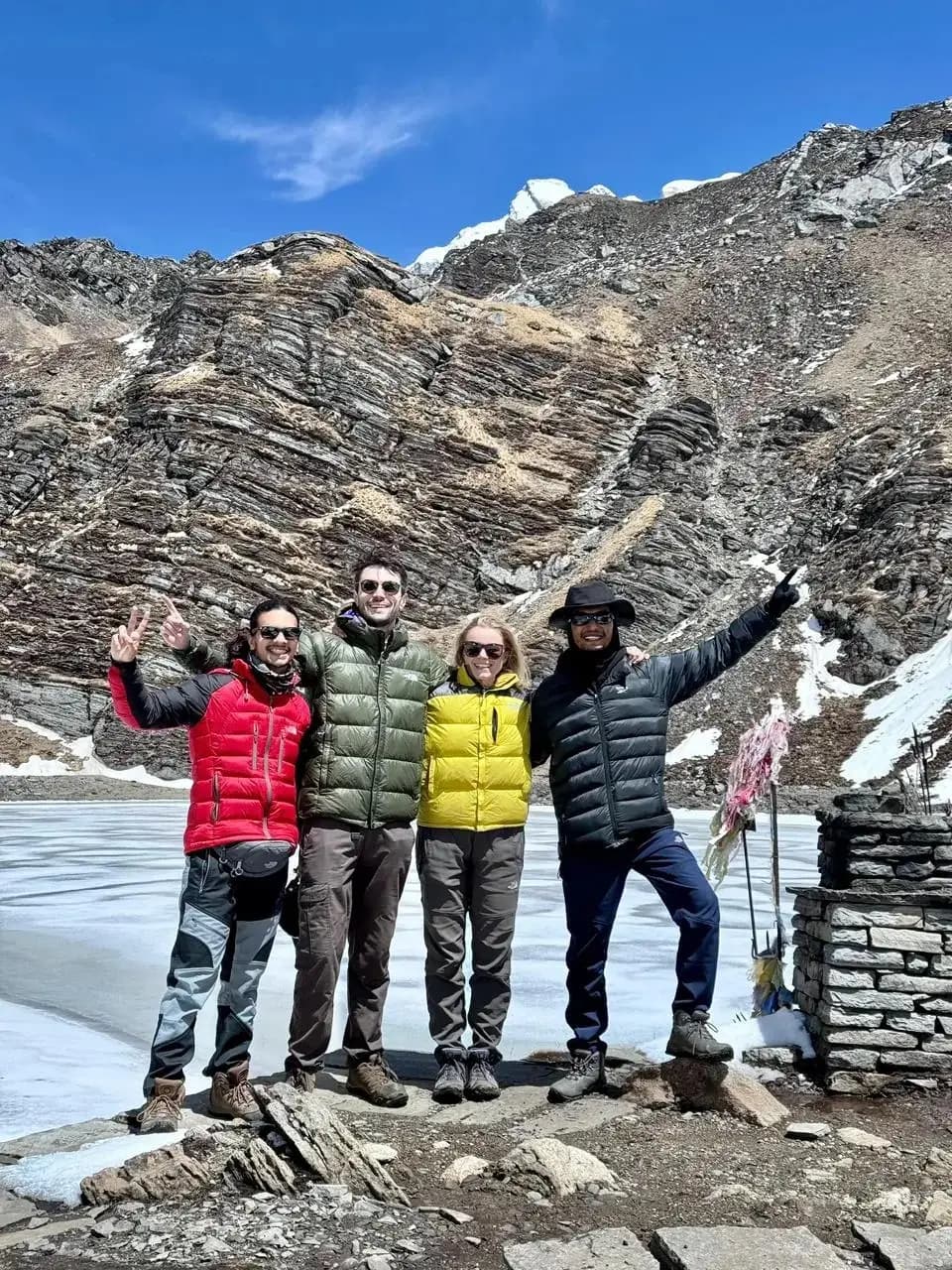
The terrain between Sikles and the lake changes character quickly. You start on open ridges with clear views of Lamjung Himal, Annapurna II and IV, then drop into oak and rhododendron forest where the trail becomes rockier and narrower. After a final two-hour push along a rougher path, the lake appears — flat, cold, glacier-fed, and surrounded by high rock walls. If you time it right you may hear blocks of ice calving into the water. I find people are surprised by how remote it feels after such a short approach.
Sikles village itself is worth your attention before you leave. The Gurung community here has worked hard to keep their heritage visible — the eco-museum has good exhibits on the Bon religion and local natural history. Homestay accommodation is available and I can arrange it ahead; the food is homemade and honest. This is a good choice for anyone who wants a real sense of the hills around Pokhara without committing to a week-long expedition.
Who this trek is for
Anyone based in Pokhara who wants a genuine mountain experience in 2-3 days. Suitable for families with older children, first-time trekkers, and repeat visitors who want something off the main Annapurna routes. No altitude concerns — the lake sits at 2,546m and the trail involves no technical terrain. A moderate level of fitness is enough.
Best views & moments
- Standing at the edge of Nepal's lowest glacial lake, ringed by Annapurna IV and Lamjung Himal
- Hearing ice calve into the still water of the glacier lake on a clear morning
- Walking through Sikles, one of the best-preserved large Gurung villages in the Annapurna foothills
- Visiting the Sikles eco-museum and the Chili Kohinbo temple above the village
- Dense rhododendron and oak forest on the approach trail from Hugu Goth
- Seasonal waterfalls along the gorge trail feeding the glacier lake
- Spotting diverse birdlife including Himalayan griffons soaring above the ridgeline
Day-by-day itinerary
Route & terrain
The trek starts with a 40-kilometre jeep ride north from Pokhara, climbing steadily above the Modi Khola valley through agricultural land and into the foothills below Lamjung Himal. Sikles sits at around 1,980m on a broad ridge with clear sightlines north to the Annapurna massif. The approach from Sikles toward Hugu Goth follows a trail through mixed oak and rhododendron forest, crossing several seasonal streams. The gradient is steady rather than steep, and the forest provides good shade in warmer months.
Hugu Goth (around 2,016m) is a small cluster of herders' shelters used as the practical base for the lake approach. From here the character of the trail changes: the path becomes rockier, the valley narrows, and waterfalls become visible on the slopes above. The final section to Kapuche Lake involves a steeper, rougher two-hour walk along a stream gorge. The lake itself occupies a glacial bowl beneath high rock walls, fed directly by meltwater. Its surface is notably flat and still in calm conditions.
The return follows the same route. Some itineraries compress day 2 and day 3 into a single long day by returning all the way to Sikles after the lake and driving back the same afternoon — that makes for a 10-hour day and is only recommended for fit, early-rising groups.
General info
Difficulty & preparation
The Kapuche Glacier Lake trek is rated Easy-Moderate. The jeep drive to Sikles is long and bumpy on a rough road — this is often harder on the body than the walking itself. The trail from Sikles to Hugu Goth is a steady gradient with no technical sections, though the forest floor can be slippery after rain. The final push from Hugu to the lake involves rougher terrain and a steeper approach along a stream gorge, which is where the 'moderate' element comes in.
The maximum altitude of around 2,546m is well below the threshold where altitude sickness becomes a concern for most people. Walking times are 5-6 hours on the main trekking day, which is manageable for anyone with basic fitness. Good footwear with ankle support is recommended for the rocky lake approach, and trekking poles help on the descent. The trail is not marked or maintained to the standard of the main Annapurna routes, so a local guide familiar with this specific trail is strongly advised.
How to prepare
Physical preparation should focus on cardiovascular endurance for 5-6 hours of walking per day. The trail from Hugu to the lake is rocky underfoot, so your footwear needs to be broken in before you arrive. Ankle support matters more on this route than pure cushioning.
The jeep road to Sikles is unpaved and bumpy in sections — if you have back problems, make sure the driver knows to take the worst sections slowly. There is no phone signal beyond Sikles, so inform someone of your plans before leaving Pokhara. Simple first aid supplies should be in your pack: blister treatment, anti-diarrheal medication, and basic pain relief are the essentials.
The best preparation is also the simplest: start early each day, eat and drink properly, and don't rush the lake approach, where a twisted ankle on the rocky trail would cause real problems.
Permits you'll need
Annapurna Conservation Area Permit (ACAP)
NPR 3,000 (foreigners) / NPR 100 (SAARC) per person
Required for the entire Annapurna Conservation Area. Buy in Pokhara at the ACAP office or Nepal Tourism Board counter.
TIMS Card (Trekkers' Information Management System)
NPR 2,000 (independent) / NPR 1,000 (group) per person
Required for all trekking routes in Nepal. Available at Nepal Tourism Board offices in Pokhara and Kathmandu.
I handle all permit paperwork as your licensed guide.
Altitude & acclimatisation
Kapuche Glacier Lake sits at approximately 2,546m — a comfortable altitude for nearly all trekkers. You are unlikely to experience altitude-related symptoms unless you have arrived in Nepal very recently and not yet acclimatised at all. Even in that case, Pokhara sits at 823m and provides a reasonable base before the trek.
The altitude gain from Pokhara to the lake (just under 1,700m) happens gradually over the jeep ride and two days of walking. There is no rapid ascent that could trigger acute mountain sickness. If you do feel headachy or nauseated on the lake approach, rest and drink water — the symptoms should pass within an hour at this altitude. A descent of a few hundred metres will resolve any discomfort quickly.
Food & accommodation
Accommodation in Sikles is primarily homestay-style, with local Gurung families providing beds and home-cooked meals. The experience is genuine rather than tourist-polished — expect shared bathrooms, wooden bed frames, and excellent dal bhat. A few basic lodges also operate in the village. Hugu Goth has very limited accommodation (a simple shelter used by herders) — most itineraries keep Sikles as the overnight base, with the lake done as a long day walk.
There are no teahouses or food resupply points between Hugu and Kapuche Lake. Pack your own lunch and snacks for the lake day. Drinking water should be treated or boiled — the stream water en route is cold and clear but should not be trusted without purification.
What to pack
This is a short, relatively low-altitude trek, so pack light. A 20-30 litre daypack is sufficient once your porter or jeep carries your main bag to Sikles. Essential items: broken-in hiking boots with ankle support, a waterproof outer layer (weather can change quickly even at this altitude), sunscreen and a hat (the ridges above Sikles get direct sun), a fleece or midlayer for evenings, a refillable water bottle or filter, and snacks for the trail.
Homestay accommodation in Sikles provides blankets, so a sleeping bag liner is enough unless you're visiting in winter (December-January), when a sleeping bag is advisable. The trail has no teahouse resupply points between Sikles and the lake, so carry enough water and food for the full day. Electrolyte sachets are useful given the physical effort.